AI agency in Birmingham
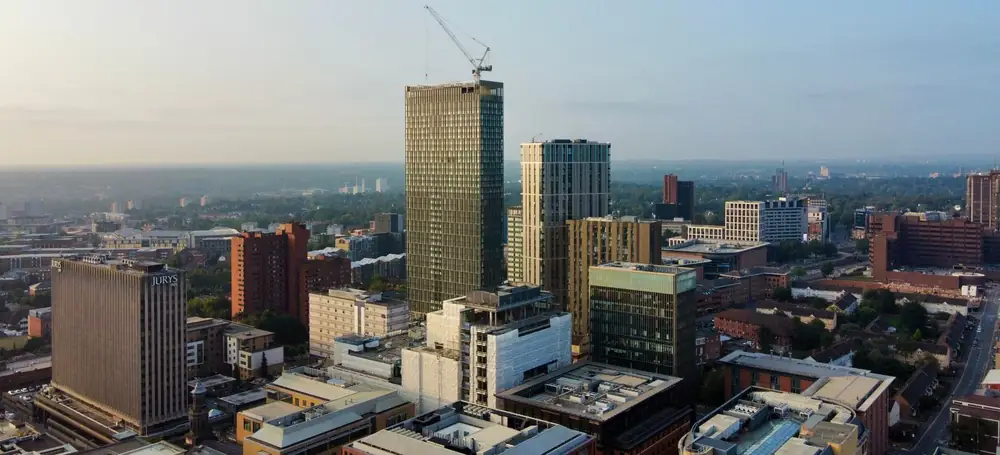
Birmingham builds and makes : contractors rebuilding the city block by block, a manufacturing base that still feeds the automotive plants around it, and warehouses along the M6 that supply half the country. Everything starts with a document someone has to read — a tender pack, a drawing, a delivery note. The task that costs most here is the tender : a hundred-page pack read three times, requirements copied by hand into a spreadsheet, and a method statement written from scratch when the last one said the same thing. We survey your ten systems, quantify what each one costs you, and open only one. The survey is free and delivered within 72 hours.
The tasks we remove first in this area
Four sectors, four tasks that cost.
A city page is worth nothing if it could be the page of the next city over. Here are the sectors we are most often called for here, the task that keeps coming back in each, and the limit we set from the start.
Construction and contractors
Tender responses, pre-quoting, valuations, site reports.
A tender pack of a hundred pages lands on a Friday. The estimator reads it three times to list the requirements, then rewrites a method statement that says what the last three said. Two days before a single price is entered.
No decision on safety, compliance or price is taken by the agent. It extracts, retrieves and pre-fills ; the estimator commits.
Manufacturing and automotive suppliers
Quoting, supplier questionnaires, customer audits, technical documentation.
A request for quotation arrives with a drawing. The estimator reopens comparable jobs from memory, one by one. Three to five days to answer a buyer who asked five workshops.
No specification validated by the agent. It retrieves, pre-fills and cites ; the estimator decides.
Logistics and warehousing
Receiving discrepancies, dock appointments, availability requests.
Three pallets announced, two received, a delivery note that says something else — and someone spends the afternoon reconstructing what happened while the docks wait.
No stock, no date, no priority committed by the agent. It says what the WMS said at the time it read it.
Sales teams
Lead qualification, proposals, follow-ups, CRM.
A lead comes in on Thursday evening. It gets called on Monday, when the rep is out of meetings. By then the prospect has two other proposals.
No discount, no price, no commitment produced by the agent. It prepares ; the rep commits.
Those four do not cover everything : Birmingham also has hauliers for whom AI for transport describes the availability request, banks, law firms, letting agents and restaurants. The survey starts from your business, not from a list.
We are also called here for : AI for transport, AI for banking, AI for legal teams, AI for real estate, AI for hospitality, AI for HR, AI for accountants.
A building contractor of sixty people
Commercial fit-out and refurbishment across the West Midlands, two estimators, fifteen to twenty tenders a year, and a folder of every method statement and pre-construction questionnaire ever submitted. The task that cost : Respond to a tender: extract the requirements and pre-fill the method statement.
A tender pack of sixty to a hundred and fifty pages — employer's requirements, preliminaries, a pre-qualification questionnaire, drawings — with a return date two weeks away.
An estimator reads the pack, copies every requirement into a spreadsheet by hand, then writes the method statement and the questionnaire answers from scratch — or from a previous bid found by memory. Two days before pricing starts.
Two to three estimator days per tender on reading and rewriting, requirements missed in the third reading, and answers that contradict the previous bid because nobody found it.
Ten years of bids in a shared folder, never indexed. Every answer already existed — in a different bid each time.
An agent reads the pack, lists every requirement with its page reference, retrieves the closest previous bids, and pre-fills the method statement and the questionnaire from validated answers — each paragraph citing the bid it comes from. It flags what has never been answered before.
The reading and pre-filling take half a day of review instead of two to three days. The estimators price ; they no longer retype, and no requirement is missed on page 87.
The agent never commits the company to anything : it extracts and pre-fills, every line traceable to its source. Compliance with each requirement, the programme and the price are decided and signed by the estimator — a commitment promised by mistake is paid for over the whole job.
This case is a working scenario, built from tasks we meet in this area. It is not the engagement of an identifiable client, and no figure above is presented as a result measured at a third party.
What the machine does, step by step.
There is nothing magical about an automation scenario : it is a sequence of steps you can read, stop and correct. Here is the one for the case above, in the order it runs.
Schematic drawing. The real scenario is built in your automation tool and stays editable by you.
Ten systems, one survey, one system opened at a time — the one with the shortest payback. Read the full method, or go back to the AI agency page.
What the closed system costs, what the open system returns.
Ranges, not promises : the real gap depends on your volumes and the state of your documents. That is exactly what the survey measures before we commit.
What we are asked before we start.
Our bids are our know-how. Where do they go ?
Nowhere. The bid library stays with you or in a space you control, the models are chosen so that your documents never train them, and access is named. It is the first question of the workshop.
Pre-filled answers will read like copy and paste.
They start from your validated answers, adapted to the requirement in front of them, and the estimator edits. What disappears is the blank page and the two days — not the judgement, which stays with the estimator.
How long before it is useful ?
The survey of the ten systems is delivered within 72 hours. Opening the first system takes two to six weeks — depending on the state of your bid library, which makes all the difference.
You are based in France. Do you come to Birmingham ?
Yes, for the survey workshop : we need to see the screens and the tools. The rest runs remotely, with a weekly call. Birmingham and the West Midlands are covered with no travel surcharge.
Our other locations in the United Kingdom.
We will tell you which system to open first.
Describe the task that costs you the most. We will tell you what is feasible, how long it takes and what it costs. If the answer is no, you will leave with the two reasons why.